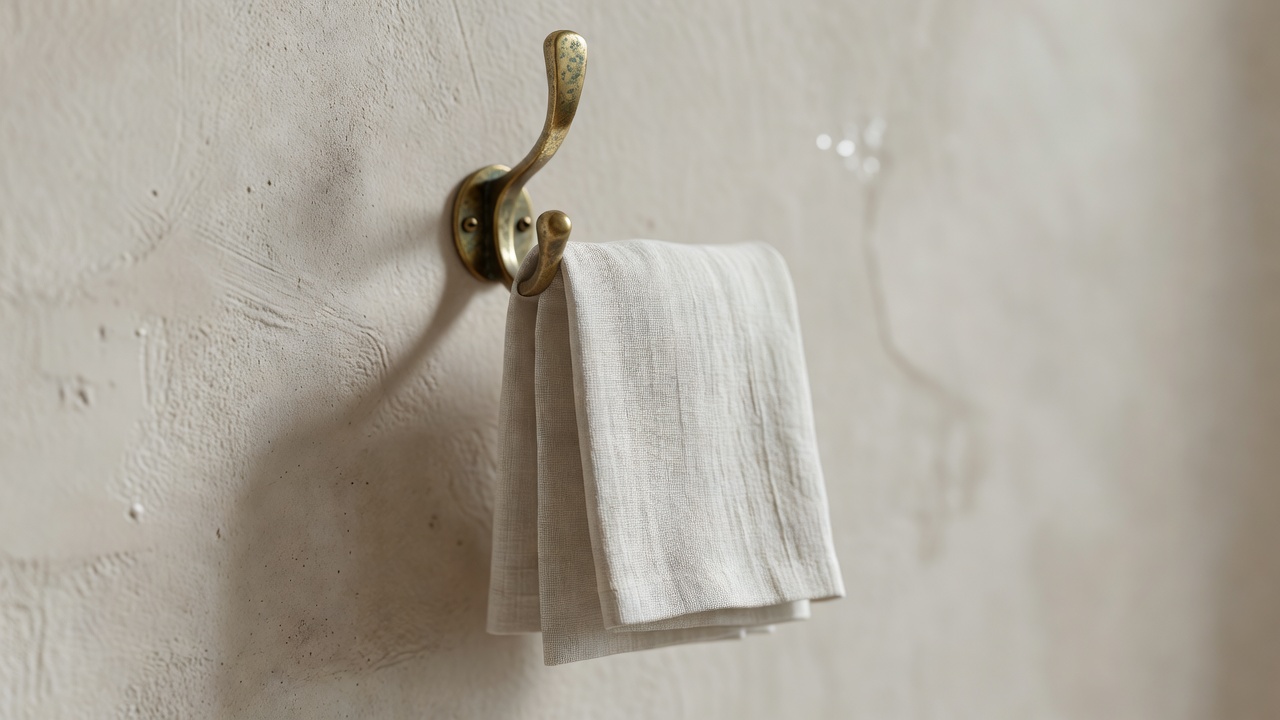
Why the wall is cheaper than the floor
A square metre of floor costs rent. A square metre of wall costs a few screws. Designers have understood this for a long time. The Frankfurt Kitchen of 1926 stacked its drawers, bins and hooks up the wall so that one person could cook within arm's reach of everything. Dieter Rams's 606 Universal Shelving System for Vitsoe, first drawn in 1960, hangs from a track fixed to the wall and can be rearranged as life changes, without ever taking up floor beyond a few centimetres.
The Shakers ran a peg rail at head height around every room, and hung on it chairs, clocks, brooms and candle sconces. Nothing sat on the floor that did not need to. In a studio, that principle is not nostalgia; it is arithmetic.
Five quiet answers
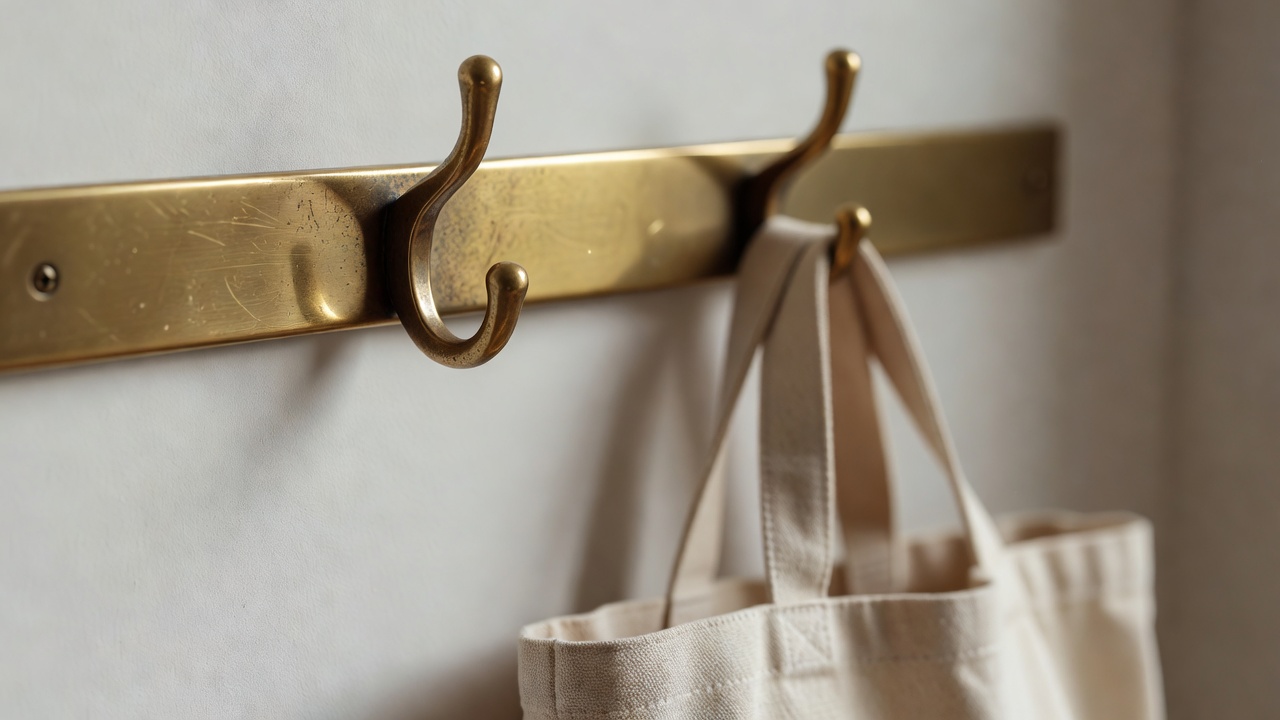
A hook rail by the door
Three to five hooks hold coats, bags and keys and make an entrance hall where none existed. Brass or iron suits a room that wants to look lived-in rather than staged.
Note: screw into studs or use anchors rated for the load; for anything heavier than a coat, check the manufacturer's weight limit.Tall, narrow shelving
Thirty centimetres deep and floor to near-ceiling, a shelving unit holds a library in the footprint of a chair.
Note: always fit the anti-tip fixings supplied, especially if children or pets share the room.Over-door hooks and organisers
A hanging wardrobe that touches no wall, which makes it a renter's friend.
Note: check the gap at the top of the door; most hooks need 2 to 3 cm.Under-bed boxes on wheels
Out-of-season clothes, spare bedding and suitcases, rolled out with a toe.
Note: lidded boxes 15 to 18 cm tall fit many frames; measure your own clearance.Boxes above the wardrobe
The forty centimetres above a wardrobe is the most unused volume in any bedroom. Matching boxes, labelled, turn it into an archive.
Note: keep heavy items low and keep the top shelf for light things you rarely need.
Open or closed
Closed doors quiet the eye. In a room where everything is visible at once, a handsome cabinet that hides the day's disorder is worth more than any amount of open shelving. Open shelves, on the other hand, are a stage: keep them for the few things that deserve to be seen, a row of books, a ceramic bowl, a plant, and leave a third of each shelf empty.
A simple rule is to keep roughly eighty per cent of your storage closed and twenty per cent open. The open twenty does the talking; the closed eighty keeps the peace.
A shelf is a sentence. Leave room for the full stop.
Fixing things to walls you do not own
Most tenancies permit more than people assume, but ask in writing before you drill. Adhesive hooks rated for a stated weight work on clean, smooth, fully cured paint and come away cleanly if removed as directed. Tension rods can hold a curtain or a shelf in an alcove. Picture-rail hooks, if your building has a rail, take surprising loads. Over-door organisers need nothing at all.
If you do drill, find the studs with a detector and check for pipes and cables before you start. Plasterboard anchors have limits, and the limit is printed on the packet. Treat that number as a ceiling, not a target. This page offers editorial ideas, not professional advice.